- Introduction
- Short Answer
- Working Principle: The Vaporizer Has Two Jobs
- Worked Example: A Factory That Peaks at 1,200 kg/h
- Compare Vaporizer Banks at the End of the Run
- How to Specify the Vaporizer and Its Connections
- Commissioning: Trend Temperature Alongside Flow
- Frequently Asked Questions (FAQ)
- Conclusion
- Sources
Introduction
On November 5, 2026, the Abu Dhabi Media Office announced a cooperation agreement to assess liquefied natural gas (LNG) supply options for industrial and commercial sites outside existing gas networks. The agreement, signed at ADIPEC 2026, covers potential production, transport, and distribution. It establishes a feasibility framework; it does not confirm construction, equipment selection, or operating performance. (mediaoffice.abudhabi)
One way to serve a factory beyond a gas network is to deliver LNG by truck and convert it back into gas at a local receiving station. This creates a design problem that a fuel inventory calculation cannot answer: can the station supply enough gas, at the required temperature and pressure, while one vaporizer is defrosting?
Short Answer
Size LNG storage from the mass needed between deliveries, allowing for delivery delays and unusable inventory. Select vaporizers from the required gas flow, outlet temperature, and outlet pressure under the site’s operating conditions.
For an ambient air vaporizer, request the guaranteed flow at the end of the operating cycle, after frost has had time to build up. Then count how many banks can actually run together during peak demand, defrost, and maintenance. A full tank cannot compensate for a vaporizer that cannot deliver the required gas.
Working Principle: The Vaporizer Has Two Jobs
A satellite station receives LNG, stores it in an insulated vessel, and withdraws liquid to a vaporizer. The resulting gas passes through the station’s pressure control and metering equipment before reaching the users. The U.S. Energy Information Administration’s LNG overview explains why natural gas is liquefied for transport and then regasified before distribution to consumers. (eia.gov)
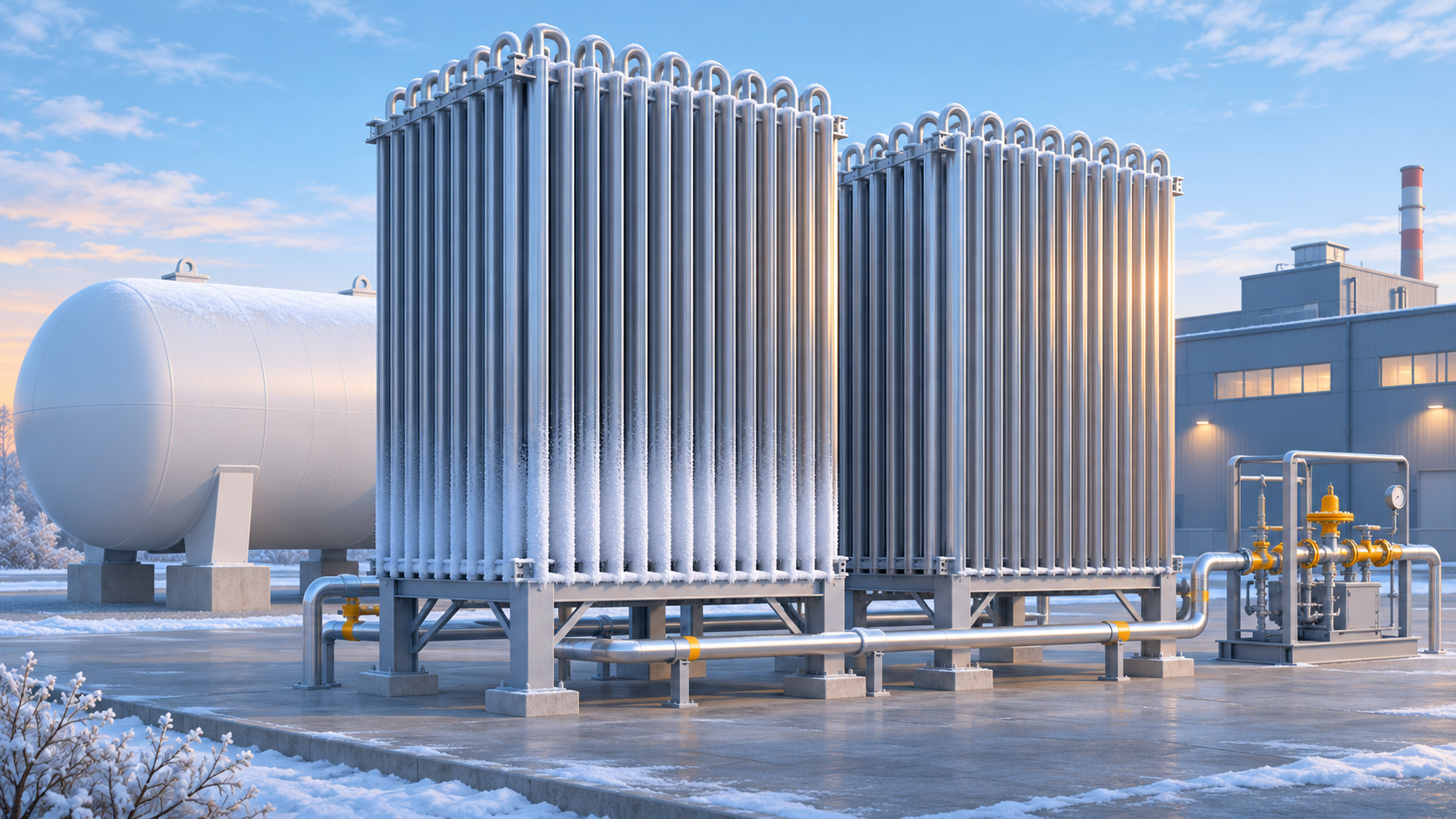
The vaporizer must supply enough heat to change the liquid into gas and then warm the gas to an acceptable outlet temperature. An ambient air vaporizer draws this heat from the surrounding air through finned tubes. Moisture can freeze on the cold fins even when the outdoor air is above freezing. As frost accumulates, it adds resistance to heat transfer. Pilot-scale research by Lee, Park, and Han examined this loss of heat transfer over time. Its results describe the tested conditions and do not establish a universal derating factor. (pubs.acs.org)
That time dependence matters when reading a datasheet. A bank that supplies the required flow and temperature when clean may fall below the outlet temperature requirement before the end of a long production run.
Worked Example: A Factory That Peaks at 1,200 kg/h
Assume a factory uses 1,200 kg/h of natural gas for four hours and 480 kg/h for the other 20 hours each day. These are illustrative inputs, unrelated to the Abu Dhabi agreement.
Quantity
Calculation
Result
Daily gas consumption
4 × 1,200 + 20 × 480
14,400 kg/day
Average gas flow
14,400 ÷ 24
600 kg/h
Peak gas flow
Highest demand in the schedule
1,200 kg/h
The daily total helps plan deliveries and storage. The peak determines the send-out rate the station needs during production. For example, 21.6 tonnes of usable inventory would cover 36 hours at the average rate. But if those 36 hours contain two full peak periods, consumption would be 23.04 tonnes: eight hours at 1,200 kg/h and 28 hours at 480 kg/h. A delivery reserve should therefore be checked against the demand schedule as well as the average.
Now assume an illustrative enthalpy rise of 800 kJ/kg between the LNG inlet and the required gas outlet. Neglect heat losses outside the vaporizer:
Peak heat duty = (1,200 ÷ 3,600) × 800 ≈ 267 kW
At the average flow, the same calculation gives about 133 kW. A selection based only on the average would miss half the required peak thermal duty. For a real project, obtain the enthalpy difference from a suitable property model or supplier calculation using the actual LNG composition, inlet state, operating pressure, and required gas outlet temperature.
Compare Vaporizer Banks at the End of the Run
Suppose the following capacities are available at the end of the specified run time, at the design weather conditions, and while meeting the gas outlet requirements. The numbers are hypothetical.
Arrangement
Available during peak
Result against 1,200 kg/h
Two 900 kg/h banks, one operating and one defrosting
900 kg/h
Short by 300 kg/h
Same two banks, both operating
1,800 kg/h
Meets peak while both are available
Three 750 kg/h banks, two operating and one defrosting
1,500 kg/h
Meets peak in this operating state
Same three banks, one defrosting and another out for maintenance
750 kg/h
Short by 450 kg/h
The three-bank arrangement is worth evaluating if peak production must continue during routine defrost. It does not cover simultaneous maintenance and defrost at peak demand. If that scenario must also be covered, consider more capacity, an independently heated backup, or an agreed production limit. Check that the changeover sequence gives each bank enough time to recover and that the headers can distribute flow as assumed.
How to Specify the Vaporizer and Its Connections
Ask suppliers to quote the same operating cases. KAF Cryogenics’ selection guidance identifies ambient conditions, run time, frosting, and outlet temperature as variables in vaporizer selection. Request a performance guarantee for the proposed arrangement rather than relying on a product range maximum. (kafcryogenics.com)
- Gas delivery: State minimum, normal, and peak mass flow; minimum acceptable gas temperature; required delivery pressure; and permissible pressure drop. If a quote uses normal cubic metres per hour, confirm its reference temperature, pressure, and gas composition before comparing it with a mass-flow requirement.
- Liquid supply: Check the pressure available at minimum tank pressure and low liquid level against elevation, line losses, vaporizer pressure drop, and downstream requirements. If pressure-fed withdrawal cannot meet the duty, evaluate a cryogenic pump and confirm its suction conditions and operating range.
- Layout and valves: Provide room for airflow, defrost drainage, inspection, and access. Specify valves and piping for their credible minimum metal temperatures. Review trapped-liquid sections for thermal expansion and check what happens downstream if the gas leaves the vaporizer colder than intended.
- Operating sequence: Define which banks run at peak demand, how changeover works, and what happens when an outlet temperature falls or a bank fails to return from defrost.
Commissioning: Trend Temperature Alongside Flow
Record gas flow, vaporizer outlet temperature and pressure, ambient conditions, and elapsed time since each bank entered service. Compare similar operating conditions. A falling outlet temperature at nearly constant flow can indicate declining heat transfer. If pressure drops while gas temperature remains acceptable, check tank pressure, valve positions, and restrictions before blaming frost.
Verify changeover at representative loads. If commissioning weather is milder than the design case, record which conditions were demonstrated and which still depend on the supplier’s guaranteed performance. For the safety design, NFPA lists the 2026 edition of NFPA 59A, issued November 19, 2025, and effective at NFPA December 9, 2025. Confirm the locally adopted requirements and edition separately. (nfpa.org)
Frequently Asked Questions (FAQ)
Does a bigger LNG tank increase maximum gas flow?
It increases inventory. Maximum gas flow still depends on liquid withdrawal, heat transfer, piping, and pressure control.
Is visible frost a reason to take a bank out of service?
Appearance alone does not establish whether a bank can meet its duty. Use the approved operating limits, cycle time, and outlet measurements to determine when changeover is needed.
Can a downstream gas heater make up for an undersized vaporizer?
Only if the system is designed for the actual inlet state and duty. A heater specified for warming gas should not be assumed capable of receiving liquid or two-phase flow.
Conclusion
Start with the factory’s demand schedule, then check two separate questions: how long the LNG inventory will last, and how much gas the available banks can deliver. The useful vaporizer rating is the flow the station can sustain at the required outlet temperature and pressure, near the end of the operating cycle, with the expected banks available.
Sources
- Abu Dhabi Media Office — Agreement on LNG Supply Options for Industrial Users. Government announcement, November 5, 2026.
- U.S. Energy Information Administration — Liquefied Natural Gas. Updated June 21, 2024.
- Lee, Park, and Han — Modeling and Analysis of Frost Growth in Pilot-Scale Ambient Air Vaporizer. Published online November 3, 2017; journal issue dated May 2, 2018.
- KAF Cryogenics — Ambient Air Vaporizer for LNG. Manufacturer selection guidance; publication date not stated.
- NFPA — NFPA 59A Standard Development. 2026 edition; issued November 19, 2025; NFPA effective date December 9, 2025. Errata 59A-26-1 issued December 17, 2025.