Introduction
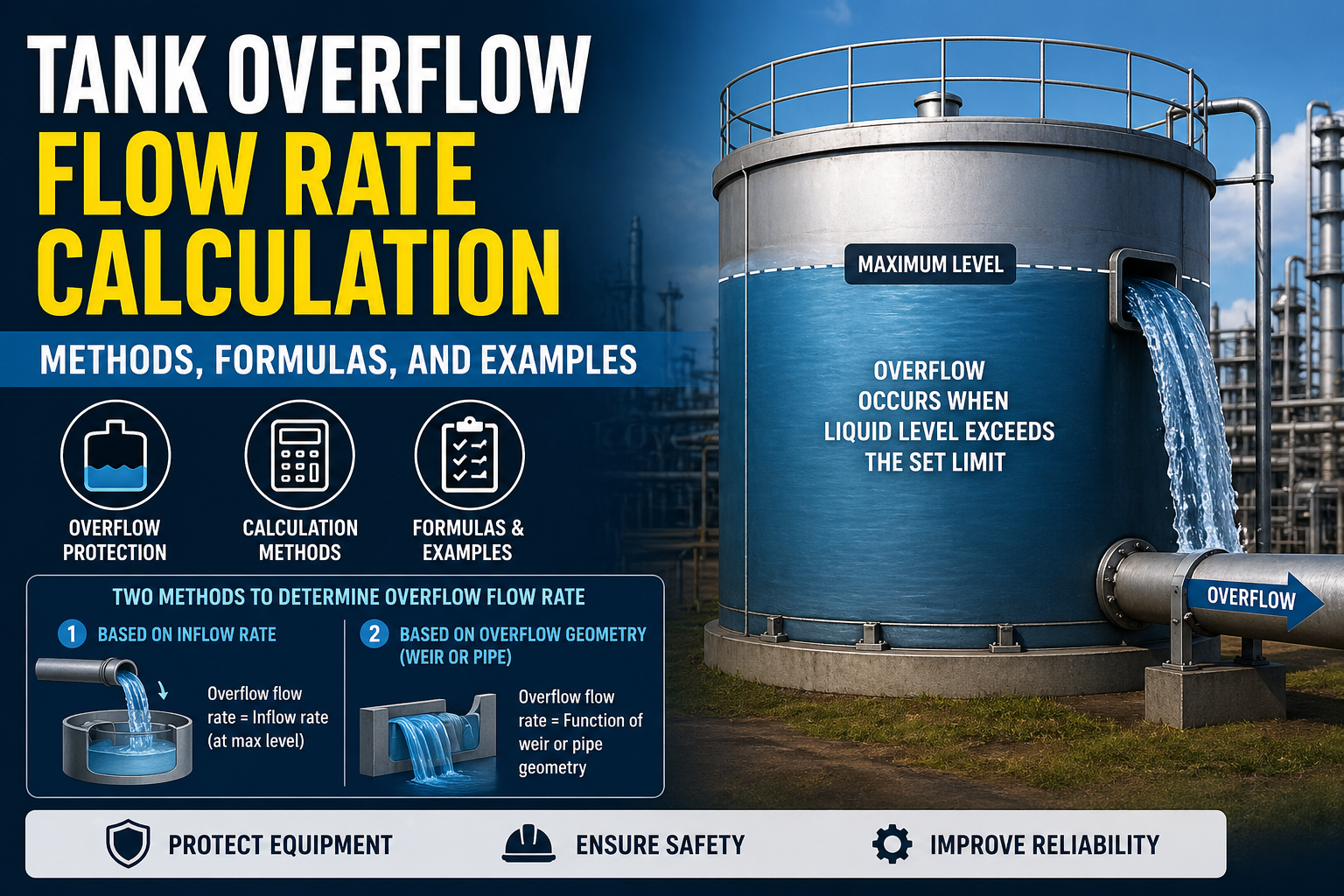
Tank overflow occurs when the liquid level exceeds a set limit and excess fluid is discharged. It is commonly used for overfill protection, safety, and equipment protection in industrial systems.
What Is Tank Overflow Flow
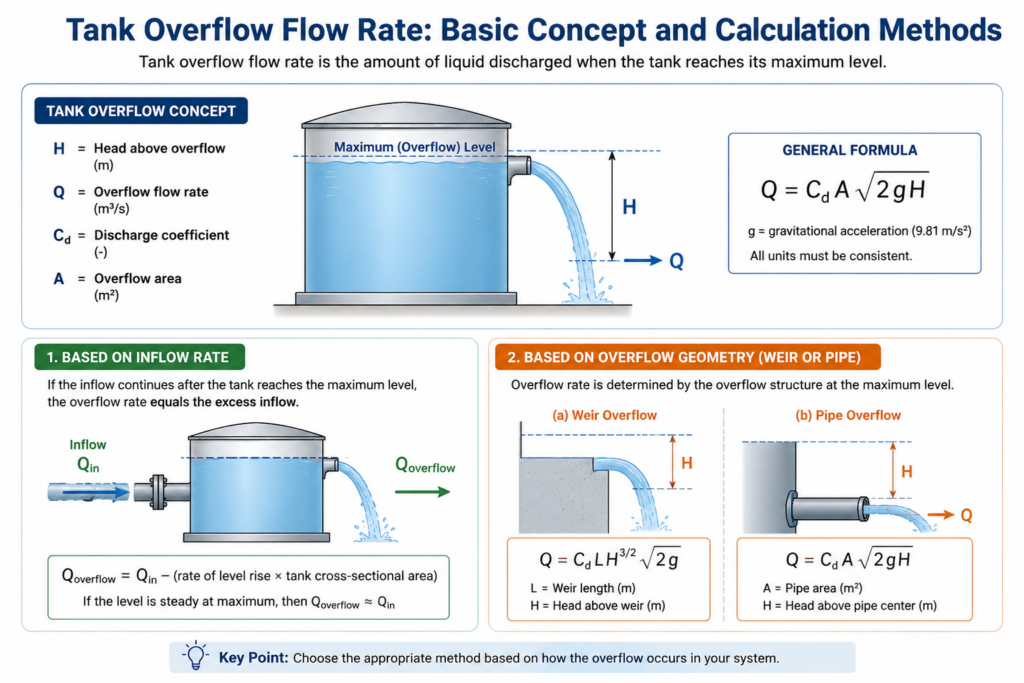
Tank overflow flow rate is the amount of liquid discharged when the tank reaches its maximum level. It is typically determined by either the inflow rate or the overflow structure capacity.
Basic Concept
There are two main ways to determine overflow flow rate:
- Based on inflow rate
- Based on overflow geometry (weir or pipe)
Case 1: Based on Inflow Rate
In most practical designs, overflow flow rate equals the maximum inflow rate.
Overflow flow rate = Inflow rate
This is the most important and commonly used approach in engineering design.
Case 2: Weir Overflow Calculation
When liquid flows over the tank edge or a weir, use the rectangular weir equation:
Q = C × b × h^(3/2)
Where:
- Q = flow rate (m³/s)
- C = discharge coefficient (typically 1.6–1.8)
- b = weir width (m)
- h = liquid height above the weir (m)
Case 3: Overflow Through a Pipe
If overflow occurs through a pipe, it behaves like an orifice flow:
Q = A × √(2gh)
Where:
- A = cross-sectional area (m²)
- g = gravitational acceleration (9.8 m/s²)
- h = head difference (m)
Practical Design Approach
In real engineering, the following rule is applied:
- Always design based on maximum possible inflow
- Consider abnormal conditions such as valve failure or control malfunction
Example
Pump capacity: 10 m³/h
→ Overflow must handle at least 10 m³/h
Design Considerations
Pipe Capacity
Ensure the overflow pipe diameter can handle the required flow rate.
Air Venting
Avoid air locking in the overflow pipe.
Blockage Risk
Consider debris, scale, or fouling inside the pipe.
Back Pressure
Discharge pressure can reduce flow capacity.
Simple Calculation Example
Condition:
- Inflow rate = 5 m³/h
- Overflow pipe = 50A
Result:
Overflow flow rate = 5 m³/h
→ A 50A pipe is sufficient for this flow → OK
Conclusion
- Overflow flow rate is usually equal to inflow rate
- Weir equations are used when overflow is geometry-controlled
- Pipe flow is treated as orifice flow
- Always design for maximum inflow conditions