Introduction
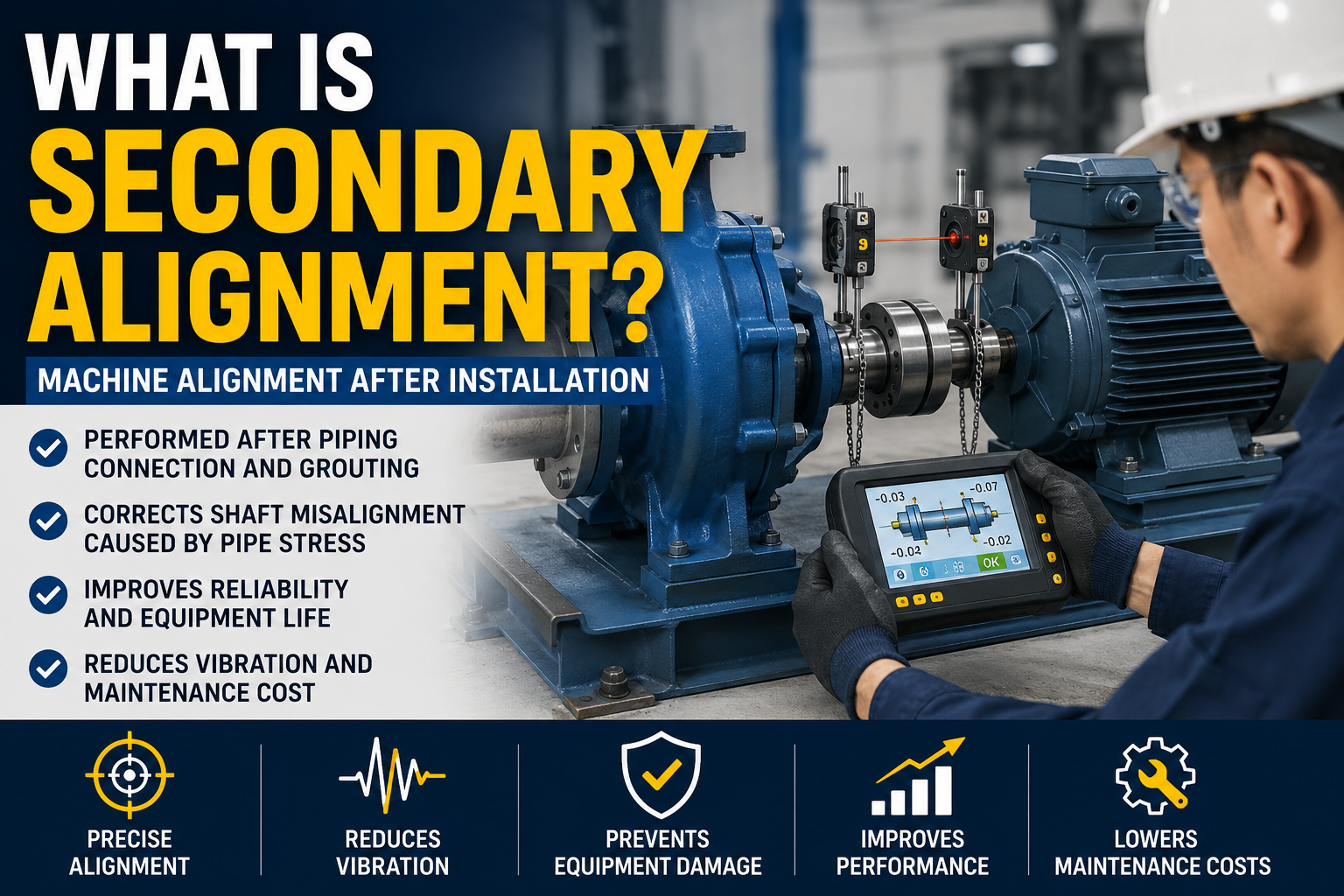
Secondary alignment is a precision adjustment process performed after machinery such as pumps, compressors, or motors has been installed and connected to piping systems. It is carried out to ensure accurate shaft alignment under actual operating and installation conditions.
In industrial plants, proper alignment is essential for preventing vibration, excessive loads, seal damage, bearing failure, and coupling problems.
What Is Secondary Alignment?
Secondary alignment refers to the final alignment adjustment of rotating equipment after piping connection, grouting, or structural settling.
During initial installation, equipment is roughly aligned. However, when piping is connected or foundation conditions change, additional stresses and displacement may occur. Secondary alignment corrects these deviations to achieve precise shaft alignment.
This process is commonly performed for:
- Pumps
- Motors
- Compressors
- Turbines
- Blowers
Why Is Secondary Alignment Necessary?
Rotating equipment alignment can change due to several factors during installation:
- Pipe stress from connected piping
- Foundation settlement
- Thermal expansion
- Grouting shrinkage
- Structural distortion
If alignment is not corrected after these changes, equipment may operate under excessive mechanical stress.
Poor alignment can cause:
- Vibration
- Coupling damage
- Bearing overheating
- Seal leakage
- Increased power consumption
- Reduced equipment life
Typical Secondary Alignment Procedure
A standard secondary alignment procedure generally includes the following steps:
- Install and roughly align the equipment
- Complete piping connection
- Verify pipe stress conditions
- Measure shaft alignment
- Adjust motor or equipment position using shims
- Recheck alignment values
- Tighten foundation bolts and perform final verification
Laser alignment tools or dial gauges are commonly used for accurate measurements.
Alignment Types
Secondary alignment usually checks two major conditions:
- Angular alignment
- Parallel alignment
Both horizontal and vertical alignment must remain within allowable tolerances specified by equipment manufacturers or industry standards.
Importance in Industrial Plants
Secondary alignment is critical for ensuring long-term reliability and stable operation of rotating equipment in industrial facilities.
Proper alignment helps reduce maintenance costs, improve equipment efficiency, and prevent unexpected shutdowns.
For this reason, secondary alignment is considered an essential step during plant construction and equipment commissioning.
Conclusion
Secondary alignment is the final precision alignment process performed after equipment installation and piping connection. It ensures that rotating machinery operates safely and efficiently under actual operating conditions.
Accurate secondary alignment helps prevent vibration, mechanical damage, and reliability problems in industrial plants