- Introduction
- Short Answer
- Working Principle: Recovery and Salt Rejection Describe Different Things
- Worked Example: Produce 100 m³/h at 45% Recovery
- Less Brine Volume Does Not Mean Less Salt
- Why Higher Recovery Can Require More Pressure
- Translate the Balance into Equipment Duties
- Engineering Practice: Review Operating Cases Together
- Commissioning and Maintenance: Close the Water Balance
- Frequently Asked Questions (FAQ)
- Conclusion
- Sources
Introduction
Veolia’s November 2026 desalination announcement describes contracts covering the Al Asilah plant in Oman and the proposed Al Hamriyah plant in the United Arab Emirates. The associated web listing is dated November 4, while its downloadable release is labelled November 5, 2026. The Al Hamriyah project includes pretreatment and remineralization technologies; its stated energy performance is a prospective project claim, rather than a reported operating measurement. (veoliawatertechnologies.com)
Drawing from announcements within the past seven days, this development highlights an important design lesson: a desalination plant needs coordinated intake, treatment, pumping, and discharge systems.
One quantity connects those systems: recovery, the fraction of membrane feed that becomes permeate.
Higher recovery reduces the feed needed for a fixed permeate output. However, it also produces more concentrated brine. That tradeoff affects membrane operation, pump duties, valves, and discharge design.
Short Answer
For a simple continuous RO system without recycle:
Recovery = permeate flow ÷ feed flow
Therefore:
Feed flow = permeate flow ÷ recovery
Brine flow = feed flow − permeate flow
Calculate these flows before selecting equipment. Then check whether the proposed recovery is feasible for the actual water chemistry, membrane arrangement, operating temperature, and product-quality requirement.
A higher recovery percentage is an operating choice with consequences—not an independent measure of plant quality.
Working Principle: Recovery and Salt Rejection Describe Different Things
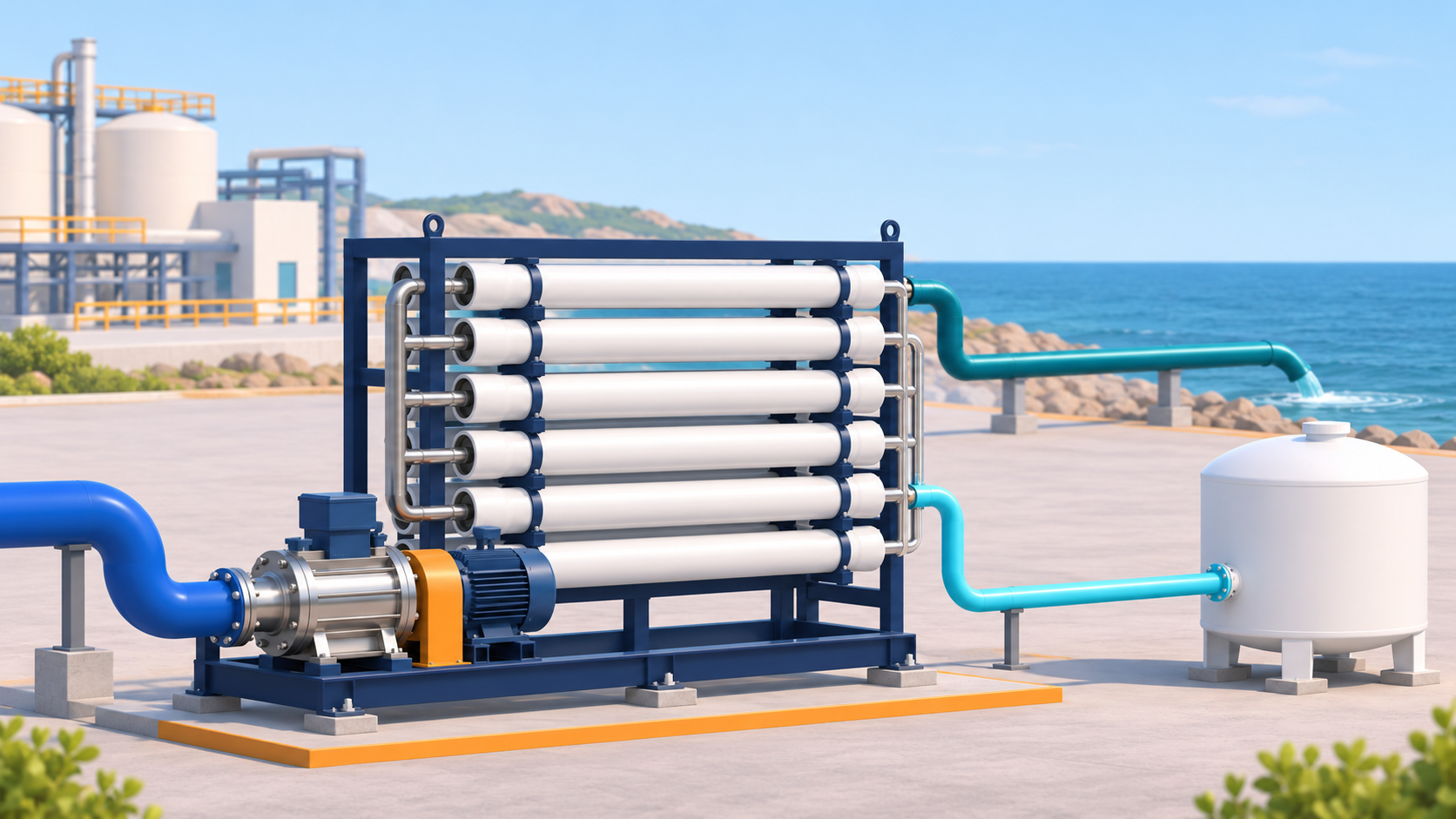
Reverse osmosis uses pressure to move water through a semipermeable membrane while retaining much of the dissolved material on the feed side. DuPont’s RO overview describes RO as a pressure-driven membrane separation process. (dupont.com)
The membrane system produces two outlet streams:
- Permeate: water that passes through the membrane.
- Concentrate, or brine: the remaining stream carrying most of the retained salts.
Recovery describes the division of water flow. Salt rejection describes the reduction in salt concentration between specified streams.
A system can have high salt rejection at a relatively modest recovery. Conversely, increasing recovery does not guarantee better permeate quality.
Always identify the boundary. Recovery across one membrane element, an entire RO pass, and the complete treatment plant are different quantities.
Worked Example: Produce 100 m³/h at 45% Recovery
Consider a hypothetical single-pass system producing 100 m³/h of permeate.
Assume steady operation, no internal recycle, and approximately additive liquid volumes. The following values are original teaching assumptions, not Veolia project specifications.
At 45% recovery:
Feed flow = 100 ÷ 0.45 ≈ 222.2 m³/h
Brine flow = 222.2 − 100 ≈ 122.2 m³/h
Now consider 50% recovery, with the same permeate output:
Feed flow = 100 ÷ 0.50 = 200.0 m³/h
Brine flow = 200.0 − 100 = 100.0 m³/h
Quantity
45% recovery
50% recovery
Permeate production
100.0 m³/h
100.0 m³/h
Membrane feed
222.2 m³/h
200.0 m³/h
Brine discharge
122.2 m³/h
100.0 m³/h
Increasing recovery by five percentage points reduces membrane feed by approximately 10%:
(222.2 − 200.0) ÷ 222.2 ≈ 10%
Brine volume falls by approximately 18%:
(122.2 − 100.0) ÷ 122.2 ≈ 18%
These reductions are different because the permeate flow remains fixed.
Less Brine Volume Does Not Mean Less Salt
Assume the feed contains 35 kg/m³ of dissolved salts, numerically equivalent to 35 g/L.
For this simplified example, neglect salt passage into the permeate, precipitation, and density-related volume changes.
The salt balance is:
Feed flow × feed concentration = brine flow × brine concentration
Combining this with the recovery definition:
Brine concentration ≈ feed concentration ÷ (1 − recovery)
At 45% recovery:
35 ÷ (1 − 0.45) ≈ 63.6 kg/m³
At 50% recovery:
35 ÷ (1 − 0.50) = 70.0 kg/m³
Quantity
45% recovery
50% recovery
Approximate brine concentration
63.6 kg/m³
70.0 kg/m³
Approximate salt discharged
7,778 kg/h
7,000 kg/h
For fixed permeate production, the higher-recovery case processes less seawater, so less salt enters the system each hour. Nevertheless, that salt leaves in a smaller brine stream with a higher concentration.
These balances do not establish an acceptable outfall design. Assess discharge concentration, flow, temperature, residual treatment chemicals, and receiving-water conditions together.
Why Higher Recovery Can Require More Pressure
As water passes through the membranes, the remaining feed becomes more concentrated.
Higher dissolved-salt concentration increases osmotic pressure, opposing water transport through the membrane. Maintaining the required permeate production can therefore require a different operating pressure or membrane arrangement.
DuPont’s FilmTec technical manual discusses the influence of concentration, pressure, temperature, and recovery on RO performance, along with water-chemistry and design constraints. (dupont.com)
Consequently, the 10% feed-flow reduction in the example does not establish a 10% reduction in pumping electricity.
Pressure, pump efficiency, and the energy-recovery arrangement also change the result. Determine them using a membrane projection and hydraulic model for the proposed operating cases.
Translate the Balance into Equipment Duties
The following is an engineering interpretation of the example, rather than a specification for either announced project.
Intake and pretreatment: The membrane feed falls from approximately 222 to 200 m³/h. However, the seawater intake may also supply filter backwashing, flushing, or other services. Do not equate membrane recovery with overall plant recovery without including those streams.
High-pressure pumping: Identify the actual flow through each pump. A system with a pressure exchanger can divide feed between different hydraulic paths. The total membrane feed is not automatically the flow handled by the main high-pressure pump alone.
Energy Recovery’s technology description explains that a pressure exchanger transfers hydraulic energy from high-pressure reject brine to incoming lower-pressure water. This makes brine flow an input to energy-recovery selection as well as discharge sizing. (energyrecovery.com)
Booster pumps: Check the pressure rise required to overcome losses in the applicable circuit. High inlet pressure and a relatively small differential pressure are separate specification conditions.
Concentrate valves and piping: Evaluate both flow cases and the associated pressure conditions. Less brine flow does not automatically justify retaining an existing valve position or reducing pipe size.
Product-water equipment: In this example, permeate remains 100 m³/h. Its storage and post-treatment requirements therefore do not shrink simply because recovery increases.
Engineering Practice: Review Operating Cases Together
Before approving a recovery change, prepare a comparison covering:
Review item
Practical question
Feed analysis
Which dissolved species and contaminants limit the design?
Seasonal temperature
Can the required output and quality be maintained across the expected range?
Membrane arrangement
Are element flows, pressure drops, and recovery limits respected?
Scaling control
Is the proposed concentration compatible with the treatment strategy?
Energy recovery
Does the device remain within its intended flow and pressure range?
Reduced production
What happens when trains or pumps are taken out of service?
A valve adjustment that changes recovery is also a process change. Check the complete operating envelope before adopting a new setpoint.
Commissioning and Maintenance: Close the Water Balance
Measure feed, permeate, and concentrate flow over the same stable interval.
Calculate:
Measured recovery = measured permeate flow ÷ measured feed flow
Then check:
Feed flow − permeate flow − concentrate flow ≈ 0
A significant imbalance can indicate measurement error, an unaccounted stream, or unstable operation. Resolve it before attributing a performance change to the membranes.
Trend conductivity, temperature, pressures, and differential pressure alongside flow. Compare performance at equivalent conditions or use the membrane supplier’s normalization method.
Also distinguish gross permeate production from useful delivered water. Flushing, off-spec diversion, and downstream treatment can affect the final plant output.
Frequently Asked Questions (FAQ)
Does 50% recovery mean 50% salt removal?
No. Recovery describes water-flow division. Salt rejection describes a concentration relationship.
Can I increase recovery by closing the concentrate valve?
That can change the operating point, but it does not establish that the resulting condition is acceptable. Check chemistry, membrane limits, pressure, and control behavior.
Does a smaller brine stream need a smaller energy-recovery device?
Possibly, but select against the full flow and pressure envelope, including reduced-production cases and the chosen arrangement.
Is membrane recovery the same as plant recovery?
Only if the boundaries and included streams are the same. Pretreatment and operational water use can make overall plant recovery lower.
Conclusion
Calculate recovery as a water balance before treating it as an efficiency target.
For fixed permeate output, higher recovery reduces feed and brine flow while increasing brine concentration. Translate those changes into membrane, pump, energy-recovery, valve, and discharge requirements before selecting equipment or changing operating setpoints.
Sources
- Veolia — Desalination Contracts in the Middle East. Downloadable release labelled November 5, 2026; web listing dated November 4, 2026.
- DuPont — Reverse Osmosis. Manufacturer technical overview; publication date not stated.
- DuPont — FilmTec Reverse Osmosis/Nanofiltration Membranes Technical Manual. Retrieved document: Form 45-D01504-en, Revision 18, September 2025.
- Energy Recovery — PX Technology. Manufacturer explanation of pressure exchange; publication date not stated.
Sources checked November 9, 2026. Calculations are illustrative. No project-specific recovery, operating pressure, or new standard requirement is asserted.