- Introduction
- Short Answer
- Working Principle: Controlled Displacement Is Not Guaranteed Delivery
- Worked Example: Convert the Process Dose into Pump Flow
- Check the Minimum Flow Before Adding Capacity
- Why Gas Bubbles Can Interrupt Dosing
- Piping and Valves Are Part of the Metering System
- Engineering Practice: Specify the Complete Operating Envelope
- Commissioning and Maintenance: Verify Liquid Delivery
- Frequently Asked Questions (FAQ)
- Conclusion
- Sources
Introduction
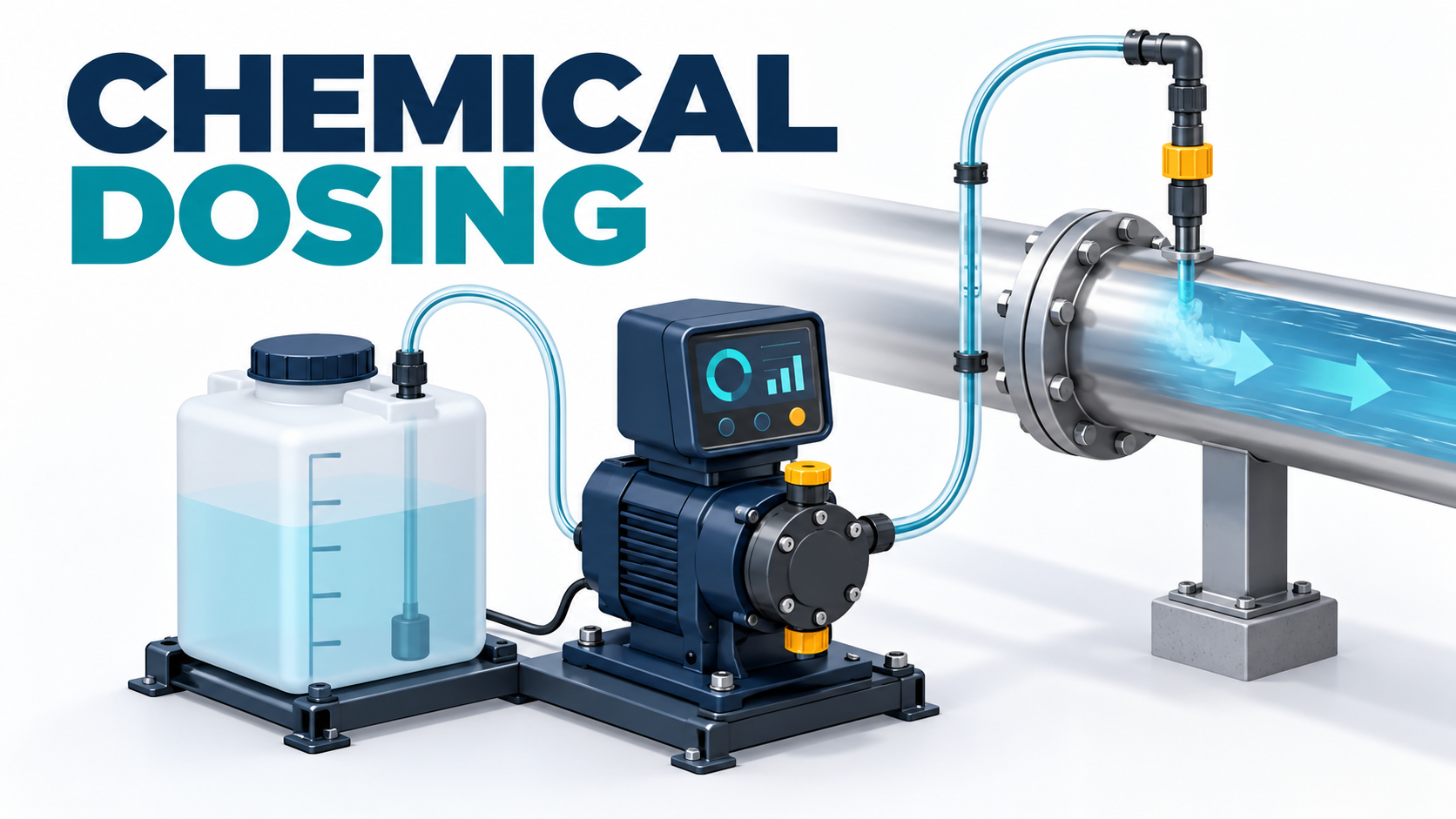
An integrated dosing pump can simplify a chemical-feed installation. It does not remove the need to calculate the dose, evaluate the piping, and verify delivery.
An October 19, 2026 manufacturer-sourced article in Chemical Engineering highlighted Pulsafeeder’s Eclipse Pro, combining a pump, motor, and controller in one package. The coverage describes rotary-gear technology and handling of off-gassing chemicals. October 19 is the article’s publication date, not a verified first-launch date. (chemengonline.com)
The manufacturer’s data sheet marked Rev10/26 confirms the integrated configuration. Its performance statements remain manufacturer specifications; they are not independent evidence of performance in every installation. (pulsafeeder.com)
With limited suitable announcements verified in the latest 48-hour search, this article uses that recent coverage to examine a practical question: how should engineers select a dosing system that works across the full process range?
Short Answer
Calculate the required chemical delivery at minimum, normal, and maximum process conditions before choosing the pump.
Then confirm:
- Chemical concentration and its reporting basis
- Required flow range and accuracy
- Suction and discharge conditions
- Compatibility of every wetted component
- Behavior with gas bubbles or changing pressure
- Protection against unintended flow and overpressure
- How actual delivery will be verified
A pump with ample maximum capacity can still be unsuitable at the lowest required dose.
Working Principle: Controlled Displacement Is Not Guaranteed Delivery
Metering pumps deliver controlled quantities of liquid using different mechanisms.
A diaphragm pump alternately expands and contracts a chamber. A rotary-gear pump transports liquid through its rotating pumping elements. A peristaltic pump moves liquid by compressing flexible tubing.
These mechanisms respond differently to pressure, gas, viscosity, and wear. Selection should therefore compare the actual service requirements rather than treating all dosing pumps as interchangeable.
For the recently covered product, Pulsafeeder identifies rotary-gear technology and integrated monitoring. That establishes the manufacturer’s intended approach. It does not establish that a particular chemical, suction arrangement, or low-flow duty is suitable without checking the applicable specifications. (pulsafeeder.com)
The useful distinction is between the commanded delivery and the quantity of chemical actually reaching the process.
Worked Example: Convert the Process Dose into Pump Flow
Consider a hypothetical treatment process:
Design input
Assumed value
Water flow
250 m³/h
Required active-chemical dose
2 mg/L
Active-chemical concentration in the dosing solution
100 g/L
These are teaching assumptions, not treatment recommendations.
Convert the water flow:
250 m³/h × 1,000 = 250,000 L/h
Calculate the active-chemical mass required:
250,000 L/h × 2 mg/L = 500,000 mg/h
500,000 mg/h = 500 g/h
Convert the active mass into dosing-solution volume:
500 g/h ÷ 100 g/L = 5 L/h
The pump must therefore deliver 5 L/h of solution for this operating case.
Keep the concentration basis consistent. A value expressed as mass percent cannot be substituted directly for grams per litre without accounting for solution density. Likewise, a concentration stated as a particular active equivalent must match the dose basis.
This arithmetic establishes feed demand. It does not demonstrate treatment effectiveness or determine the required dose for a real process.
Check the Minimum Flow Before Adding Capacity
Now assume the process can operate at:
- Water flow: 25 m³/h
- Required active dose: 1 mg/L
- Solution concentration: 100 g/L
The required solution flow becomes:
25,000 L/h × 1 mg/L = 25 g/h
25 g/h ÷ 100 g/L = 0.25 L/h
The required operating range is therefore:
5 ÷ 0.25 = 20:1
This is the process turndown requirement. It does not automatically establish the necessary pump model.
Suppose a hypothetical supplier guarantees an absolute delivery error of ±0.05 L/h under defined conditions:
Delivery rate
Absolute error
Error relative to delivery
5 L/h
±0.05 L/h
±1%
0.25 L/h
±0.05 L/h
±20%
These are invented teaching values, not specifications for Eclipse Pro or another product.
The example explains why engineers must distinguish accuracy expressed as a percentage of reading, a percentage of full scale, or an absolute flow quantity.
Ask for guaranteed performance at the required low-flow point and relevant pressure. Display resolution alone does not establish dosing accuracy.
Why Gas Bubbles Can Interrupt Dosing
Sodium hypochlorite is an example of a chemical that can present gas-handling challenges.
ProMinent’s technical explanation, dated June 2021, describes gas accumulation in suction lines and diaphragm-pump heads. Gas can reduce the delivered liquid quantity and, in severe cases, interrupt metering entirely. (prominent.us)
In a reciprocating chamber, part of the motion may compress gas rather than displace the intended liquid volume.
Different manufacturers offer different approaches, including gas detection, controlled venting, or alternative pumping mechanisms. A general claim of handling off-gassing chemicals should be checked against the actual service envelope.
For a supplier inquiry, document tank arrangement, minimum liquid level, suction lift, temperature, tubing route, and expected chemical condition. Ask how priming, gas clearance, and low-flow delivery are demonstrated.
Piping and Valves Are Part of the Metering System
The following functions should be reviewed separately:
Function
Design question
Backpressure control
Does the pump need a defined discharge condition for reliable metering?
Anti-siphon protection
Could chemical move into the process without the intended pump delivery?
Pressure relief
What protects the system if the discharge becomes blocked?
Injection-point check function
How is reverse flow from the process limited?
Maintenance isolation
How will the equipment be safely isolated and depressurized?
ProMinent’s accessory guidance distinguishes backpressure, anti-siphon, and relief functions. Their suitability depends on the device and installation. Do not assume that a valve provides every function because it is installed on a dosing line. (prominent.us)
The same manufacturer’s injection-valve guidance explicitly states that its described injection valves are not absolutely leak-tight shut-off devices. A check function should therefore not be treated automatically as maintenance isolation. (prominent.com)
Select the pressure protection, return destination, materials, and isolation arrangement for the actual chemical and equipment ratings.
Engineering Practice: Specify the Complete Operating Envelope
The following checklist is an engineering synthesis for preparing a useful inquiry:
- State the chemical precisely. Include concentration, temperature, density, viscosity, and relevant changes during storage.
- Calculate each operating case. Pair process flow and dose with the resulting solution flow.
- Define the pressure conditions. Include normal operation, minimum suction level, and maximum credible discharge pressure.
- Set the accuracy requirement. Identify the measurement basis and the operating points where it must be achieved.
- Check all wetted materials. Include tubing, seals, valves, fittings, and instruments.
- Define control behavior. Establish the response to lost signals, stopped process flow, empty tanks, and delivery faults.
- Agree on verification. Specify how actual chemical delivery will be demonstrated.
Integrated electronics can reduce component count, but responsibility for these interfaces still needs to be explicit.
Commissioning and Maintenance: Verify Liquid Delivery
A running indication demonstrates that the drive has received an operating command. It does not independently establish liquid injection.
During commissioning, verify delivery using an agreed method suitable for the chemical and installation. Where a timed volume or mass measurement is used, define the test duration, measurement uncertainty, pressure conditions, and concentration basis.
Record a baseline at representative low and normal duties.
For troubleshooting, compare pump command, measured delivery, tank level, pressure, and process response. An unexpected treatment result could involve chemical strength, mixing, analyzer behavior, or process demand as well as the pump.
Manufacturer maintenance intervals also require context. Use the supplied instructions and actual service conditions rather than transferring an advertised interval to every chemical-feed installation.
Frequently Asked Questions (FAQ)
Should I simply select a pump twice the calculated flow?
No universal oversizing factor applies. Check the required maximum capacity together with low-flow performance and the project’s design margin.
Does an integrated flow display prove the correct active dose?
It may support delivery monitoring, but active dose also depends on solution concentration and process flow.
Can bubbles matter when the motor runs normally?
Yes. Gas can interfere with liquid delivery without stopping the motor.
Does an injection check valve replace an isolation valve?
Not automatically. Verify its stated function and leakage characteristics.
Conclusion
Dosing-pump selection starts with a mass balance and finishes with verified delivery.
Calculate the minimum and maximum solution flows, define accuracy at both, and evaluate gas handling, pressure, piping, and control behavior. Integrated equipment can simplify the package; a clear process specification makes that package useful.
Sources
- Chemical Engineering — Chemical Dosing and Metering Is Streamlined with This All-in-One Integrated System. Manufacturer-sourced coverage published October 19, 2026.
- Pulsafeeder — Eclipse Pro Data Sheet. Document marking: ecpspec_Rev10/26; exact release day not stated.
- Pulsafeeder — Eclipse Pro Rotary Gear Pumps. Publication date not verified.
- ProMinent — Accurate Dosing Quantities Even with Outgassing Media. Dated June 2021.
- ProMinent — Backpressure and Relief Valves. Publication date not stated.
- ProMinent — Injection Valves for Motor-Driven Metering Pumps. Publication date not stated.
Sources checked October 26, 2026. The calculations are illustrative. No new standard edition, regulatory effective date, or application-specific treatment dose is asserted.