- Introduction
- Short Answer
- Working Principle: Cooling Makes Water Removable
- Pressure Dew Point Is Not Atmospheric Dew Point
- What Does “Class 4” Actually Describe?
- Refrigerated or Desiccant: Start with the Application
- Worked Example: The Dryer Uses Part of the Pressure Budget
- Rated Flow Needs Its Rating Conditions
- Energy Comparison Must Follow the Load Profile
- Maintenance: Check the Drain Before Blaming the Dryer
- Frequently Asked Questions (FAQ)
- Conclusion
- Sources
Introduction
An October 26, 2026 product announcement in Compressed Air Best Practices highlighted ZEKS HSH and HSG HeatSink refrigerated air dryers. The search was widened to the past seven days because no suitable distinct announcement was verified within the preferred 48-hour window. October 26 is the coverage date; the original product-launch date was not independently established. (airbestpractices.com)
ZEKS’s product page describes refrigeration cycling with thermal storage and integrated filtration. These are manufacturer specifications, not independently demonstrated savings for a particular plant. (zeks.com)
The announcement raises a useful engineering question: before comparing electricity consumption, have we specified air that will remain sufficiently dry throughout the distribution system?
For students and beginning engineers, the answer starts with pressure dew point, minimum downstream temperature, and the pressure available at the equipment.
Short Answer
Choose the required air quality first, then select and compare dryers that can achieve it under the actual operating conditions.
Confirm:
- Required pressure dew point at a defined pressure
- Lowest relevant downstream air temperature
- Maximum flow and dryer inlet conditions
- Allowable pressure loss
- Condensate removal and filtration requirements
- Part-load performance and maintenance arrangements
A low-energy dryer is useful only if it delivers the required air quality and leaves sufficient pressure for downstream equipment.
Working Principle: Cooling Makes Water Removable
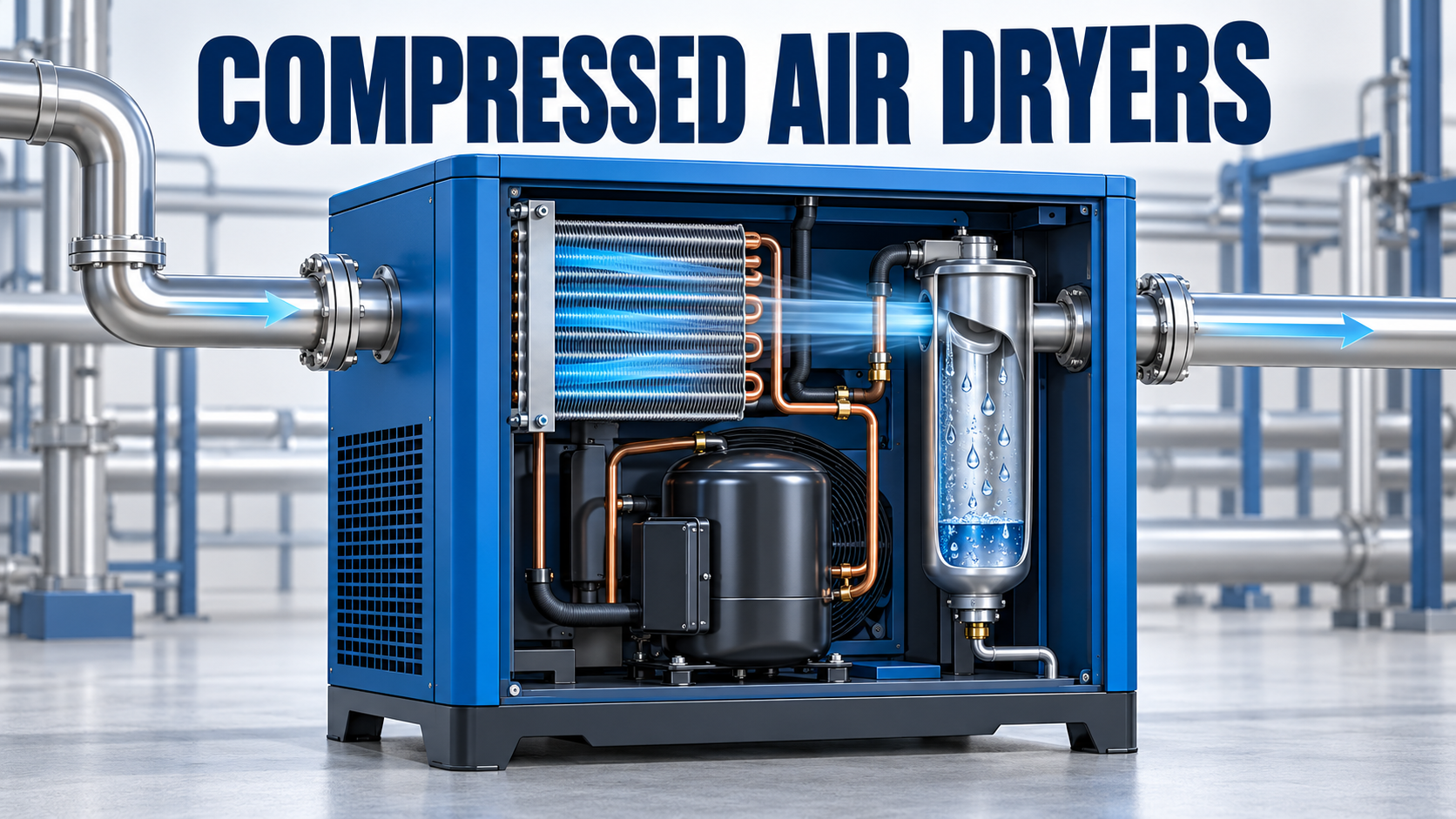
A refrigerated dryer cools compressed air until some water vapor condenses. A separator removes the resulting liquid, and a drain discharges it from the compressed-air system.
The UK government’s Energy Technology List guidance explains this cooling-and-draining mechanism. It also identifies dryer pressure loss as part of the system’s energy burden. (etl.energysecurity.gov.uk)
Cooling alone is therefore insufficient. The condensed water must actually leave the air stream and the equipment.
ZEKS describes a thermal-storage arrangement in which the refrigeration system cycles while stored cooling capacity supports air treatment. Its page also identifies precooling/reheating functionality.
Reheating can increase the leaving-air temperature without undoing the moisture removal. This helps explain why dryer outlet temperature and pressure dew point are different quantities.
Pressure Dew Point Is Not Atmospheric Dew Point
Pressure dew point is the temperature at which water vapor begins to condense at the specified compressed-air pressure.
Atmospheric dew point refers to a different pressure condition. The values cannot be compared directly without accounting for pressure.
Atlas Copco’s dryer-selection guidance makes this distinction and emphasizes specifying dew point at operating pressure. (atlascopco.com)
Consider air with an actual pressure dew point of +3°C, evaluated at approximately the same pressure throughout the downstream section:
Downstream air temperature
Interpretation
+20°C
Above the stated dew point
+5°C
Above it, with a small temperature margin
0°C
Below it; condensation becomes possible
−5°C
Condensation and freezing require consideration
This is a teaching example, not a recommended operating margin. Pressure changes, temperature variation, measurement uncertainty, and the guaranteed dryer performance must be evaluated for a real installation.
An indoor dryer cannot protect an outdoor branch merely because the compressor room is warm.
Likewise, insulation slows heat transfer but does not establish a permanent minimum temperature in a stagnant pipe. Check the conditions during shutdown and low demand as well as normal operation.
What Does “Class 4” Actually Describe?
ISO 8573-1:2010 classifies compressed-air purity with respect to particles, water, and oil. ISO identifies it as Edition 3, published in April 2010, with a revision under development. A revision project does not itself establish a replacement edition or a new legal effective date. (iso.org)
For moisture, the UK Energy Technology List explicitly references BS ISO 8573-1:2010 and a Class 4 pressure-dew-point rating of no more than +3°C.
Consequently, a manufacturer’s statement of “Class 4 PDP” addresses moisture performance. It does not establish the same class for particles or oil.
Specify the required contaminants separately and identify where compliance must be demonstrated.
This article uses the public ISO scope and government guidance; it does not infer additional requirements from unreviewed standard clauses.
Refrigerated or Desiccant: Start with the Application
Refrigerated drying is commonly considered where a positive pressure dew point satisfies the application.
For substantially lower dew points, adsorption drying is another established approach. The Compressed Air and Gas Institute handbook, Seventh Edition, February 2017, describes compressed-air treatment technologies and the consequences of moisture for piping, instruments, valves, and cylinders. (cagi.org)
The selection question is therefore not which technology is universally better.
Ask whether the required air quality, environmental conditions, operating profile, and maintenance resources support the proposed arrangement.
A small branch with demanding dryness requirements may justify evaluating local additional treatment. Compare that option with drying the entire plant supply to the same condition.
The comparison must include installation complexity, operating energy, air consumption where applicable, and verification at the point of use.
Worked Example: The Dryer Uses Part of the Pressure Budget
Consider a hypothetical system at its design flow:
Item
Assumed pressure or pressure loss
Pressure entering the treatment section
7.00 bar(g)
Dryer pressure loss
0.20 bar
Filters
0.15 bar
Distribution piping and fittings
0.25 bar
The estimated point-of-use pressure is:
7.00 − 0.20 − 0.15 − 0.25 = 6.40 bar(g)
If the equipment requires 6.50 bar(g) under that operating condition, the assumed arrangement has a 0.10 bar shortfall.
These are original teaching assumptions, not product specifications.
The calculation shows why the dryer cannot be selected independently of filters and distribution piping.
Investigate the loss distribution before increasing compressor discharge pressure. Possible changes include different treatment equipment, improved piping, or removal of unnecessary restrictions.
Also review loaded-filter conditions and peak demand. A satisfactory pressure reading during light demand does not establish adequate pressure when several users operate together.
Rated Flow Needs Its Rating Conditions
A catalogue flow is meaningful only with its associated conditions.
The ZEKS product page states performance conditions including 100 psig inlet pressure, 100°F inlet-air temperature, and 100°F ambient temperature, referencing ISO 7183 Table 2, Option A2. The page does not identify the ISO 7183 edition.
For an inquiry, provide actual maximum flow, its reference conditions, minimum operating pressure, maximum inlet temperature, and cooling-air or cooling-water conditions.
Ask the supplier to confirm corrected capacity and dew-point performance at those conditions.
Do not invent correction factors or assume that two products with the same nominal flow will perform identically in a hot compressor room.
Energy Comparison Must Follow the Load Profile
Cycling operation can reduce refrigeration demand when the drying load falls. However, a product description alone does not quantify annual savings.
Request comparable performance across the expected operating profile, including low-load and standby conditions.
For illustration, suppose one proposal uses 2 kW less average electrical power over 4,000 operating hours:
2 × 4,000 = 8,000 kWh per year
This is an assumed comparison, not a ZEKS performance claim. It excludes any change in compressor energy caused by pressure loss and excludes other auxiliaries.
The UK Energy Technology List’s treatment of pressure-drop-corrected energy performance reinforces the need to consider both dryer electricity and its effect on the compressed-air system.
Maintenance: Check the Drain Before Blaming the Dryer
A practical commissioning baseline should record inlet conditions, flow, pressure loss, measured pressure dew point, and drain operation.
For troubleshooting, distinguish among:
- Water vapor remaining above the required level
- Liquid water carried through the separator
- Failed condensate discharge
- Downstream condensation in colder piping
- Contamination introduced after the dryer
These are investigation paths, not diagnoses from one symptom.
Provide accessible isolation, depressurization, and drain-maintenance arrangements. An untreated-air bypass also needs an operating policy: maintaining air supply through it may temporarily sacrifice the specified air quality.
Frequently Asked Questions (FAQ)
Does warm outlet air mean the dryer is ineffective?
No. Reheated outlet air can have a lower moisture content. Verify pressure dew point.
Will a particulate filter remove water vapor?
A particulate-filter rating does not establish vapor removal. Confirm the required treatment function.
Is Class 4 moisture performance suitable for every instrument-air system?
No. Check equipment requirements, environmental conditions, and the project specification.
Should I choose the largest dryer available?
Select against corrected capacity and operating range. Maximum capacity alone does not establish suitability.
Conclusion
Compressed-air dryer selection begins with the required condition of the air at its destination.
Define pressure dew point, check the coldest relevant downstream conditions, close the pressure budget, and verify rated capacity at actual inlet conditions. Then compare energy use across the operating profile.
That sequence connects advertised efficiency to reliable plant operation.
Sources
- Compressed Air Best Practices — ZEKS HeatSink Dryer Announcement. Coverage dated October 26, 2026.
- ZEKS — HSH & HSG Series HeatSink. Primary product specifications; publication date not stated.
- UK Energy Technology List — Refrigerated Air Dryers with Energy Saving Controls. Government guidance; publication date not stated.
- ISO — ISO 8573-1:2010. Edition 3, April 2010; public scope and publication information.
- Atlas Copco — Selecting the Best Compressed Air Dryer. Manufacturer technical guidance; publication date not verified.
- CAGI — Compressed Air Treatment, Chapter 3. Compressed Air & Gas Handbook, Seventh Edition, February 2017.
Sources checked October 31, 2026. Numerical examples are illustrative; no application-specific dew-point margin or guaranteed energy saving is asserted.