- Introduction
- Short Answer
- Working Principle: Cleanup and Conditioning Serve Different Purposes
- Physical Absorption: Why the Solvent Circuit Matters
- Worked Example: Constant Gas Flow Can Hide a Larger Cleanup Load
- Catalyst Protection Requires Specific Limits
- Pump Selection: Use the Actual Solvent Properties
- Valve Selection: Pressure Reduction Can Change the Phase
- Engineering Practice: Manage Interfaces and Maintenance Together
- Frequently Asked Questions (FAQ)
- Conclusion
- Sources
Introduction
A renewable feedstock does not remove the need for careful gas purification. Before biomass-derived synthesis gas can become methanol, its composition and contaminants must meet the requirements of the downstream process.
An Air Liquide announcement dated October 14, 2026 describes a license and engineering agreement for Perpetual Next’s planned biomethanol facility in Delfzijl, the Netherlands. The announced design capacity is 220,000 tonnes per year, with Rectisol gas purification and Lurgi methanol synthesis among the technologies to be supplied. This is a project announcement, not evidence of operating production. (engineering-technologies.airliquide.com)
Further coverage appeared on October 23, but the underlying manufacturer announcement is older than the preferred seven-day news window. No newer primary announcement suitable for this topic was verified.
The project highlights a practical lesson: gas cleanup establishes operating conditions that directly affect piping, solvent pumps, control valves, and maintenance.
Short Answer
Select equipment from the complete process envelope, including gas composition, contaminant loading, solvent properties, temperature, pressure, and operating changes.
For a syngas-cleaning system, engineers should establish:
- Which contaminants must be removed
- Their normal and maximum inlet loads
- Required outlet specifications
- Gas and solvent operating conditions
- Potential gas release during pressure reduction
- Requirements during startup, shutdown, and feedstock changes
A nominal gas-flow figure alone is insufficient for defining the cleanup duty.
Working Principle: Cleanup and Conditioning Serve Different Purposes
Syngas is a mixture containing hydrogen and carbon monoxide, together with other components that depend on its production route.
The U.S. Department of Energy’s thermochemical conversion overview explains that biomass gasification produces syngas requiring cleanup and conditioning before catalytic conversion. It identifies contaminants such as tars, acid gases, ammonia, alkali metals, and particulates. It also distinguishes sulfur polishing from adjustment of the hydrogen-to-carbon-monoxide ratio. (energy.gov)
These tasks answer different questions:
Task
Engineering question
Contaminant removal
What could damage equipment, foul surfaces, or impair the catalyst?
Composition adjustment
Does the gas have the composition required by the synthesis process?
Temperature and pressure control
Is the stream suitable for the next operation?
Consequently, a gas stream can satisfy one requirement while failing another. Meeting the desired hydrogen-to-carbon-monoxide ratio does not demonstrate acceptable sulfur content.
Physical Absorption: Why the Solvent Circuit Matters
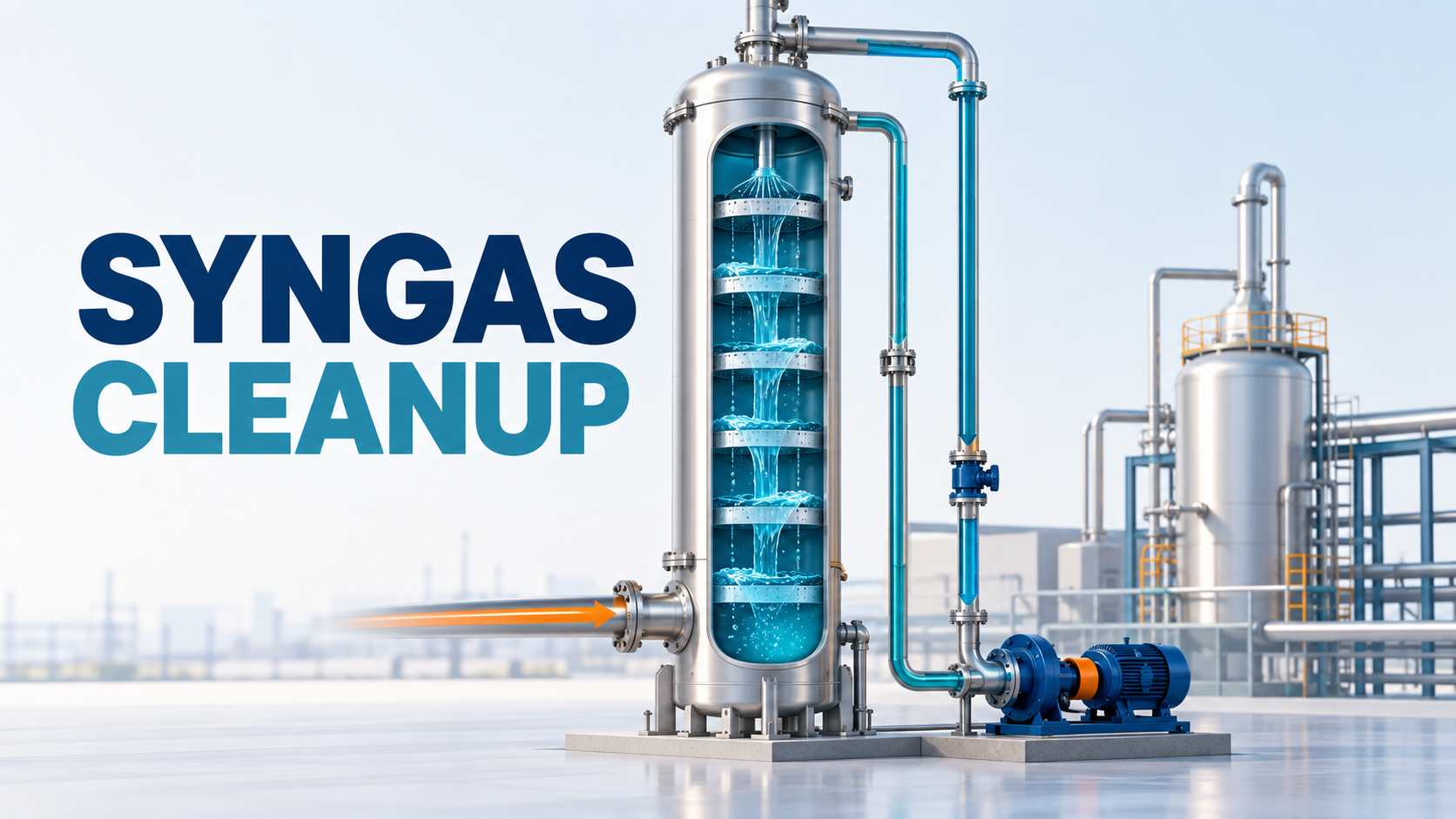
Air Liquide’s Rectisol technology description identifies cold methanol as the physical solvent used to absorb acid gases and trace contaminants. The loaded solvent is regenerated through flashing and stripping. These are general technology descriptions, not a published equipment list for the Delfzijl project. (engineering-technologies.airliquide.com)
The solvent is therefore part of a circulating separation process.
A useful distinction is:
- Lean solvent: solvent prepared for further absorption duty
- Rich solvent: solvent carrying absorbed components toward regeneration
“Lean” does not necessarily mean chemically pure. The actual composition must come from the process design.
The engineering implication is that pumps and valves can encounter streams with different dissolved-gas contents, temperatures, and phase behavior even when the principal liquid is described as methanol.
Worked Example: Constant Gas Flow Can Hide a Larger Cleanup Load
Consider a hypothetical inlet stream:
Quantity
Normal case
Contaminant excursion
Dry gas flow at a defined reference condition
100,000 reference m³/h
100,000 reference m³/h
One contaminant concentration
50 ppmv
200 ppmv
Assume both concentrations use the same dry basis and that the dilute-gas volume fraction represents mole fraction.
The normal contaminant flow, expressed as equivalent gas volume at the same reference condition, is:
100,000 × 50 ÷ 1,000,000 = 5 reference m³/h
During the excursion:
100,000 × 200 ÷ 1,000,000 = 20 reference m³/h
The total gas flow is unchanged, but the inlet load of this contaminant is four times higher.
Over eight hours, the corresponding incoming quantities are 40 and 160 reference cubic metres.
These figures are an original teaching example, not project data. They do not determine solvent circulation, absorber dimensions, or guard-bed life.
Actual removal depends on the required outlet concentration, equilibrium, mass transfer, solvent condition, and equipment performance. Nevertheless, the calculation shows why a flow-based capacity check can miss a major change in purification duty.
For a real specification, identify each relevant chemical species, its concentration basis, and the duration of credible excursions.
Catalyst Protection Requires Specific Limits
“Clean gas” is too vague to serve as a battery-limit specification.
Topsoe’s methanol catalyst information describes a guard catalyst intended to protect synthesis catalysts from impurities including iron, sulfur, and chlorine. Its technical discussion of e-methanol design also emphasizes that sulfur species can require different protection strategies. The latter addresses e-methanol rather than this biomethanol project; its relevance here is the need to characterize impurities explicitly. (topsoe.com, topsoe.com)
Obtain the applicable limits from the selected process licensor and catalyst supplier. Do not transfer an advertised purification capability directly into a universal catalyst inlet limit.
Also agree on sampling locations, analytical methods, and reporting units. A specification is difficult to enforce if the plant cannot reliably measure the quantity it promises to control.
Pump Selection: Use the Actual Solvent Properties
The following questions are an engineering checklist for a solvent-pump inquiry, rather than published design requirements for the announced project.
What is the pumped composition?
Identify methanol, water, absorbed gases, and other relevant constituents.
What conditions occur at the suction?
Document vessel pressure, minimum liquid level, temperature, and suction-line losses.
Could gas evolve before or inside the pump?
Evaluate the mixture’s phase behavior. A solvent containing dissolved gas needs more consideration than a pure-liquid property entry.
What operating range is required?
State minimum, normal, and maximum flow, including recycle or minimum-flow arrangements where applicable.
What containment is required?
Specify the fluid hazards, materials compatibility, seal arrangement, and destination of any collected leakage.
The practical objective is to give the supplier enough information to assess the service. Selecting a pump from nominal flow and discharge pressure leaves important questions unresolved.
Valve Selection: Pressure Reduction Can Change the Phase
Solvent regeneration intentionally releases absorbed components. Other pressure reductions may also cause vapor formation or gas evolution.
For a simple liquid, Emerson’s control-valve flashing guidance explains that flashing occurs when downstream pressure remains below the liquid’s vapor pressure. The resulting liquid-vapor flow can cause erosion; valve geometry and materials influence damage potential. (emerson.com)
A loaded solvent mixture requires a suitable mixture-phase assessment. Do not assume that a pure-methanol vapor-pressure check captures the release of dissolved gases.
For each pressure-reducing valve, provide upstream and downstream conditions, fluid composition, flow range, and the expected outlet phase.
Then review the downstream piping as well. A valve selected for a phase-changing service does not establish that the connected line has adequate capacity or a suitable mechanical design.
Engineering Practice: Manage Interfaces and Maintenance Together
A replicated plant concept still needs site-specific interface checks.
Use a shared stream table to connect the gasification, cleanup, regeneration, and synthesis packages. For each interface, record:
- Normal and limiting compositions
- Flow, pressure, and temperature ranges
- Permitted contaminant excursions
- Required measurements
- Agreed response to an off-specification stream
For maintenance, establish baseline trends for relevant pressures, temperatures, differential pressures, solvent condition, and outlet analyses.
Interpret these measurements together. An increasing differential pressure may justify investigation, but it does not independently identify the cause. Similarly, acceptable outlet gas quality at one instant does not establish remaining guard-bed capacity.
Provide access for sampling, inspection, and replacement during layout development. These provisions are easier to accommodate before the equipment arrangement is fixed.
Frequently Asked Questions (FAQ)
Is biomass-derived syngas automatically suitable for methanol synthesis?
No. Its composition and contaminants must satisfy the selected synthesis process requirements.
Does a physical solvent eliminate the need for polishing?
Not automatically. Required treatment depends on inlet conditions and the downstream specification.
Can a larger control valve prevent flashing?
Valve size alone cannot eliminate a phase change imposed by process conditions.
Can a standardized design be copied without reviewing feedstock?
The feedstock and site operating envelope still require verification against the design basis.
Conclusion
Biomethanol development connects feedstock processing, purification, and synthesis. Equipment selection must connect them too.
Quantify contaminant loads, define outlet requirements, and evaluate solvent phase behavior before finalizing pumps, valves, and piping. These steps turn a general requirement for “clean syngas” into information that equipment suppliers and operators can use.
Sources
- Air Liquide — Delivering Syngas-to-Methanol Technology for Perpetual Next. Published October 14, 2026.
- Powertrain International — Perpetual Next and Air Liquide: An Ace Pair for Bio-Methanol. Coverage dated October 23, 2026; used to establish renewed reporting.
- U.S. Department of Energy — Thermochemical Conversion Processes. Publication date not stated.
- Air Liquide — Lurgi Rectisol. Publication date not stated.
- Topsoe — Methanol Synthesis Catalysts. Publication date not stated.
- Topsoe — The Hidden Risks in E-Methanol Plant Design. Exact publication date not verified.
- Emerson — Control Valve Flashing. Publication date not stated.
Sources checked October 25, 2026. No new standard edition, regulatory effective date, or project-specific equipment selection is asserted.