- Introduction
- Short Answer
- Why the Hydrogen Route Changes Driver Selection
- Working Principle: What a Centrifugal Compressor Does
- Define an Operating Envelope Before Selecting Equipment
- Anti-Surge Protection Is a System Design Task
- Piping and Cooling Decisions Affect the Package
- Dry Gas Seals Need Reliable Support Utilities
- Frequently Asked Questions (FAQ)
- Conclusion
- Sources
Introduction
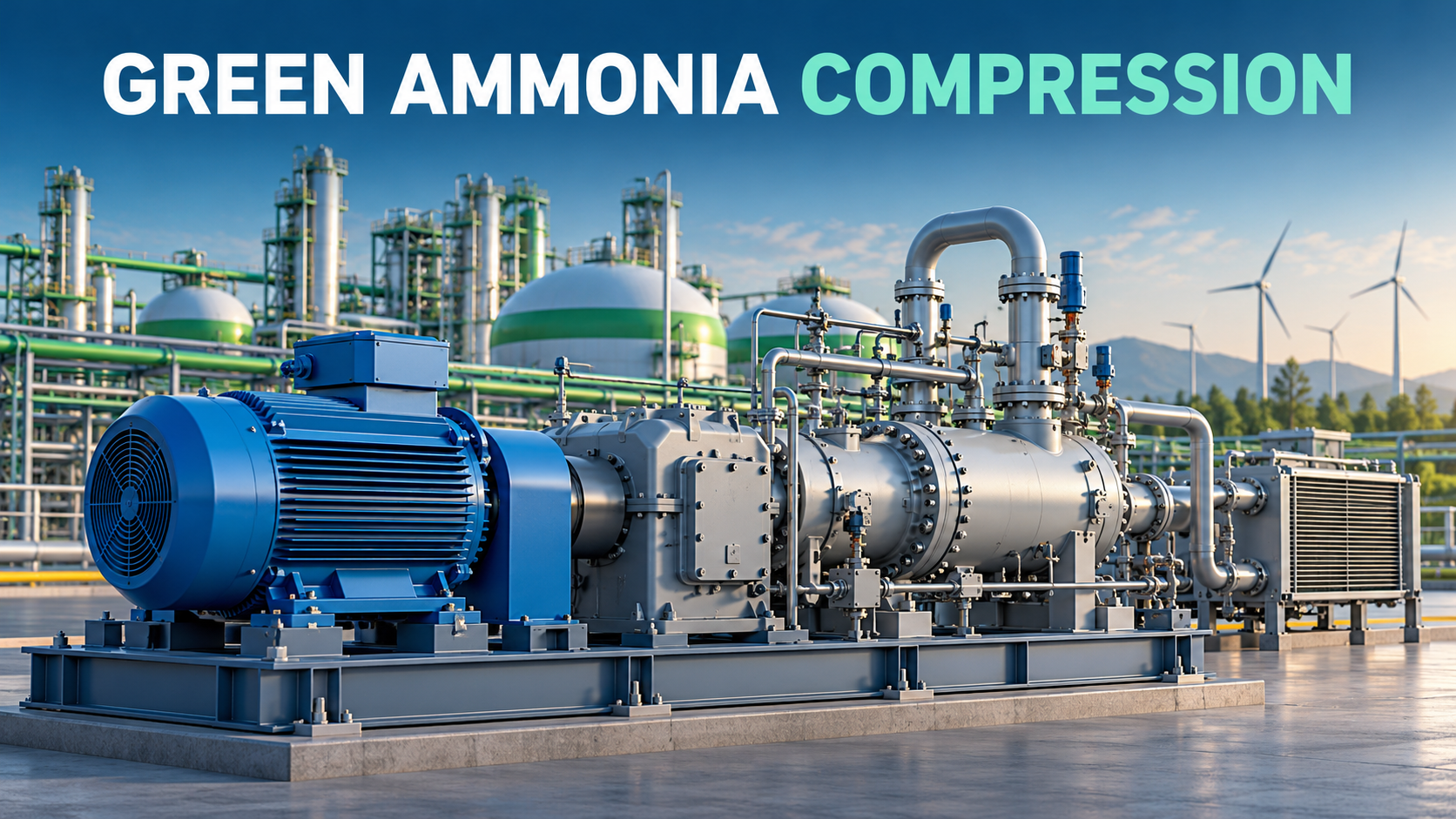
On October 14, 2026, Everllence announced its first PARSYN compressor-train order for AM Green’s Kakinada green ammonia project in India. The package includes two barrel-type compressors, an electric motor, a gearbox, coolers, dry gas seals and associated systems. Delivery is scheduled for late 2027, with commissioning planned for 2028.
No suitable new primary announcement was identified within the latest 48 hours, so this article uses that verified development from the past seven days.
The engineering significance extends beyond the compressor itself. Changing how hydrogen is produced changes the plant’s steam balance—and can change how major machinery should be driven. The practical lesson is to select the compressor, driver, utilities and protection systems together.
This is an equipment-order announcement, not evidence of completed commissioning or demonstrated operating savings. (everllence.com)
Short Answer
For a green ammonia compressor package, engineers should evaluate:
- Gas composition and actual inlet volume
- Suction and discharge conditions across all operating cases
- Compressor maps and available turndown
- Electrical supply, driver rating and starting method
- Cooling requirements and pressure losses
- Anti-surge valves and recycle piping
- Seal gas availability during operation and shutdown
- Maintenance access and package boundaries
Replacing a steam turbine with an electric motor requires a new assessment of utilities and transient behavior. Matching rated shaft power alone is insufficient.
Why the Hydrogen Route Changes Driver Selection
Everllence explains that conventional ammonia plants commonly use steam-turbine-driven synthesis gas compression, drawing on steam associated with natural-gas-based hydrogen production. Its announced green ammonia configuration uses an electric motor because considerably less process steam is available.
The useful engineering inference is that a driver belongs within the plant energy balance. A turbine that fits an existing steam-rich facility may be a poor fit when the hydrogen-production route changes.
Before comparing machinery quotations, prepare a utility balance for normal operation, startup, minimum production and shutdown.
Review item
Steam turbine drive
Electric motor drive
Main energy interface
Steam supply and exhaust conditions
Electrical supply and starting arrangement
Upstream dependency
Steam generation and header availability
Grid or on-site generation availability
Speed arrangement
Turbine governor and train design
Fixed-speed or variable-speed arrangement
Important upset
Steam pressure or supply loss
Voltage disturbance or power loss
Plant integration
Steam, condensate and possibly vacuum systems
Switchgear, protection and possibly a drive system
These are screening considerations, not a rule that either driver is always preferable. The choice depends on site conditions, operating requirements and lifecycle economics.
Working Principle: What a Centrifugal Compressor Does
A centrifugal compressor transfers shaft energy to a continuously flowing gas through rotating impellers. Diffusers then convert part of the gas velocity into static pressure. Multiple stages can provide the required overall pressure rise.
The Atlas Copco centrifugal-compressor guide explains these fundamentals and the role of intercooling. Its industrial-air examples should not be used as performance guarantees for hydrogen–nitrogen synthesis gas service. (atlascopco.com)
A key selection issue is the difference between standard flow and actual inlet volume.
For preliminary reasoning:
Actual volume flow = mass flow ÷ inlet density
A given mass flow occupies more volume when density decreases. Therefore, changing suction pressure, temperature or gas composition can change the volumetric duty seen by the compressor.
For example, if inlet density decreases by 10% at unchanged mass flow, actual inlet volume increases by approximately 11.1%. This arithmetic illustration does not predict the corresponding compressor head, power or surge margin; those require the vendor’s gas-property calculations and performance maps.
Define an Operating Envelope Before Selecting Equipment
A single rated point cannot describe a plant that starts, stops or changes production rate.
Build a case table covering:
- Normal production
- Minimum continuous production
- Maximum throughput
- Highest suction temperature
- Lowest suction pressure
- Startup and loop pressurization
- Rapid loss of downstream demand
- Compressor trip and restart
For each case, record gas composition, mass flow, actual volume, suction pressure and temperature, required discharge pressure, and available utilities.
Do not assume that renewable electricity necessarily reaches the compressor as an uncontrolled fluctuating supply. Storage, grid connection and hydrogen buffering can alter the operating profile. Define the actual project architecture first.
Everllence’s green ammonia engineering overview identifies power strategy, renewable variability, ramp rates and turndown as planning inputs. Those are appropriate questions for a vendor discussion, rather than proof that every proposed train can satisfy every load profile. (everllence.com)
Anti-Surge Protection Is a System Design Task
At sufficiently low flow for a particular operating condition, a centrifugal compressor can become unstable. Surge can involve pressure oscillations and flow reversal.
An anti-surge system typically opens a recycle valve to return discharge gas toward the suction, increasing flow through the compressor. Emerson’s application guidance describes this arrangement, including cooling in the recycle path. (emerson.com)
For procurement, request more than valve size and flow coefficient. Ask how the proposed assembly addresses:
- Required capacity across protection cases
- Opening response under differential pressure
- Actuator and instrument-air availability
- Fail action and loss-of-signal behavior
- Noise, vibration and temperature
- Interaction with the controller and piping
A large valve with inadequate response may fail to provide the intended protection. Conversely, an oversized assembly can complicate control.
The engineering review should examine the complete chain: measurement, calculation, command, actuator movement and resulting gas flow. Dynamic simulation can test whether the combined response is adequate during specified disturbances.
Piping and Cooling Decisions Affect the Package
The following are practical review questions for the project team, rather than published details of the Kakinada installation.
Where are the pressure boundaries? Confirm whether quoted suction and discharge pressures apply at compressor nozzles or package battery limits. Otherwise, cooler, filter and piping losses may be omitted or counted twice.
What happens during sustained recycle? Recycled gas carries energy back toward the inlet. Establish the resulting temperatures and cooling duty for the intended recycle arrangement.
Where can liquid collect? Check gas dew points, cooling conditions, low points, drains and separation requirements. A gas compressor package needs a clear basis for preventing unacceptable liquid carryover.
How does the piping move? Review thermal expansion, supports and nozzle loads with the machinery vendor. Maintenance access should also remain practical after insulation, platforms and valves are installed.
Which volumes matter during a trip? Include the relevant piping, coolers and connected equipment in the dynamic model. An isolated compressor model cannot represent the complete installed system.
Dry Gas Seals Need Reliable Support Utilities
The announcement includes a dry gas sealing system. That makes seal support an important interface.
John Crane’s July 8, 2023 technical explanation describes the need for clean, dry, conditioned seal gas and suitable monitoring. Filters, heaters, separators or boosters may be part of the arrangement, depending on the application. (johncrane.com)
Ask the vendor to explain seal-gas supply during startup, normal operation, depressurization and standstill. Establish what happens when normal process-derived seal gas is unavailable.
For maintenance planning, document filter monitoring, leakage trends, alarm responsibilities and access for servicing. Requirements must follow the selected seal system and project specification. This article does not claim to reproduce or verify the requirements of a particular API 692 edition.
Frequently Asked Questions (FAQ)
Does an electric motor automatically make an ammonia plant more efficient?
No. Evaluate total plant energy use, electrical losses, steam balance, operating profile and the electricity source. Driver efficiency alone does not determine overall performance.
Can a variable-speed drive eliminate anti-surge protection?
Do not assume so. Speed control and surge protection serve different functions. Require the vendor to demonstrate protection across the specified operating and trip cases.
Does “two compressors arranged in parallel” mean two independent standby machines?
No. Physical arrangement, process-flow arrangement and redundancy are different concepts. Confirm the process flow diagram, shaft arrangement and operating philosophy before interpreting the configuration.
Should guaranteed performance cover only full load?
The contract should reflect commercially important operating cases. Include clearly defined conditions and acceptance criteria for any required part-load guarantees.
Conclusion
The October 14 announcement illustrates how a change in hydrogen production can reshape compressor-driver selection and plant utility integration.
A useful compressor specification defines the operating envelope, utility interfaces, protection strategy and maintenance requirements before equipment is selected. Reviewing those interfaces together gives engineers a stronger basis for comparing bids and preparing the plant for reliable operation.
Sources
- Everllence — First PARSYN order for green ammonia in India. Published October 14, 2026.
- Everllence — Green ammonia compression and plant planning. Publication date not stated; accessed October 19, 2026.
- Atlas Copco — Working principle of a centrifugal compressor. Publication date not stated; accessed October 19, 2026.
- Emerson — Compressor anti-surge control valves. Publication date not stated; accessed October 19, 2026.
- John Crane — Eight things to know about API 692 seal gas systems. Published July 8, 2023. Manufacturer commentary; no standard edition or effective date independently verified.